

The Erotic
Psssst...it is not what you have been told


There is a word that has been flattened and inflated, stretched and pulled and extracted from like few others.
A word that once held poetry, mysticism, spirituality and the deep intelligence of the body itself.
The erotic.
When most people hear it, they conflate it with sex. But the erotic is so much bigger, so much more magical than that.
The erotic is your body’s capacity to experience life as sacred sensation.
It is the moment when something touches you not just emotionally, not just intellectually, but VISERCALLY.
Sunlight on skin.
Music ripping open the chest.
Pain cutting through the ribcage like knives.
The ache of longing when looking at the ocean.
All these moments hold deep eroticism.
The erotic is where pleasure and beauty and longing and mystery meet.
It is deep presence.
When the body becomes an instrument through which the melody of life can be deeply felt.
It is the art of being fully alive in a body.
In a world that rewards efficiency and speed, the erotic is quietly radical, because the erotic asks us to feel.
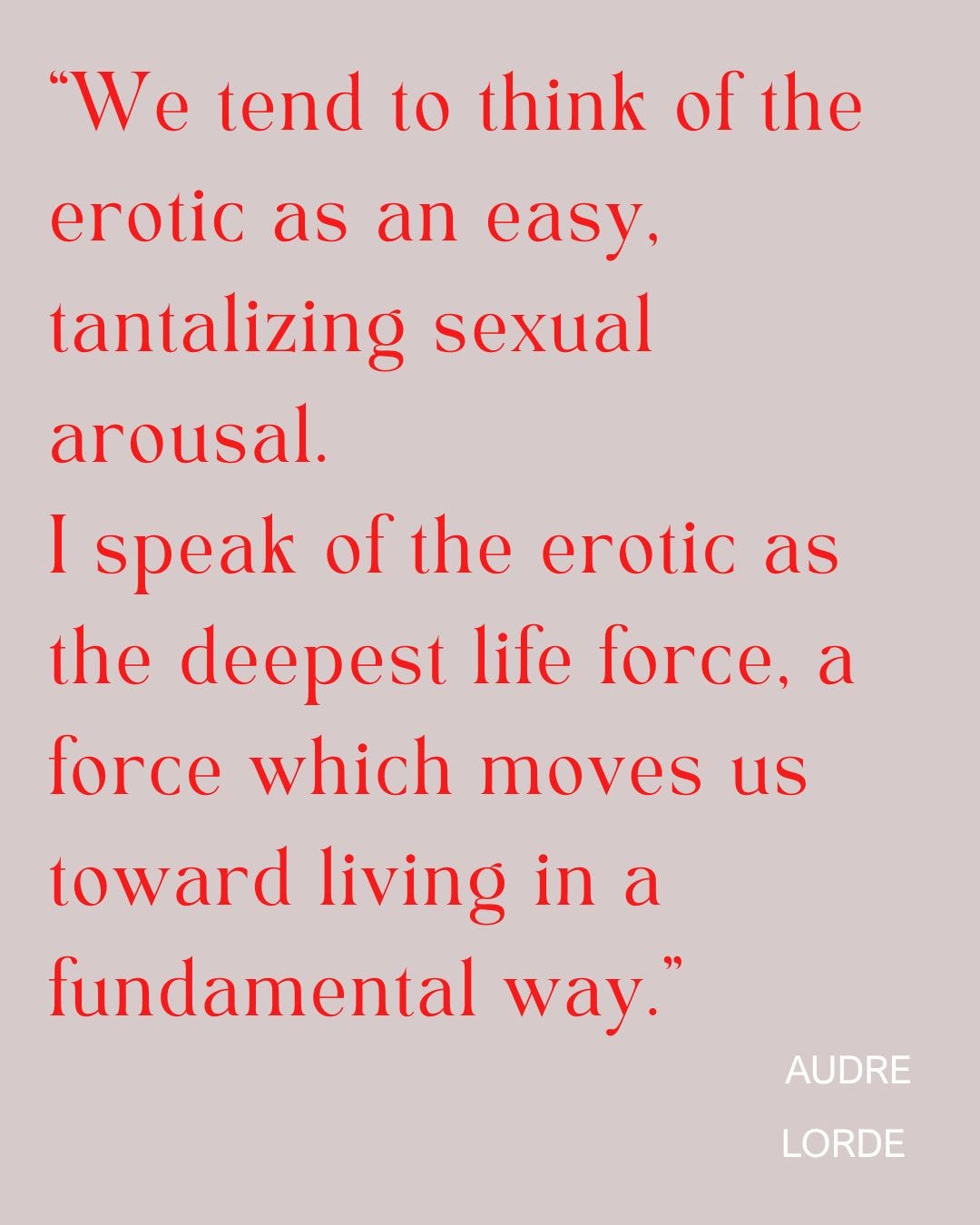
The erotic is not decorative.
Not trivial.
Not something extra that appears only in moments of romance or sexuality.
It is a life force.
The same force that draws us toward beauty, intimacy, creativity and truth.
When we lose contact with the erotic, life flattens.
We function, but we barely live.
Many women I meet (not excluding myself) tell me some version of the same story. “Something is off”, “I feel disconnected”. A great numbness. Often the result of a lifetime of conditioning that lead to a freeze response out of fear.
Women are raised to care. To manage. Households, emotions, expectations, work, etc. Over time, often subtly, attention moves away from the body. Life becomes something to manage, rather than to experience. The erotic goes quiet. It hasn’t disappeared. It’s just not being listened to.
In “The Erotic Mind”, psychologist Jack Morin writes that modern psychology has often misunderstood eroticism by looking at it through two narrow lenses.
One lens treats the erotic primarily sexually and as pathology. Something dangerous, sinful, or psychologically suspect at best. This perspective has deep roots in psychoanalysis and religious morality. It assumes that erotic impulses are dangerous forces that must be controlled, or corrected.
Eroticism is viewed through the language of dysfunction, deviation and disorder. As if by entertaining the erotic we will step into chaos. As if the erotic is something we must restrain, or it will become destructive.
Even though this lens sees the great power of the erotic, it is viewed with suspicion. A dark lens if you will.
The other lens that Morin calls “the neat and clean perspective” tries to sanitize, reducing the erotic to something tidy, predictable and functional.
This view emerged later through behaviorism and modern sex therapy. Here the erotic is not feared, but it is achingly simplified.
Sex is treated as a predictable physiological function, something that can be optimized through technique, improved through communication and measured through performance. In this framework, healthy sexuality becomes something very orderly.
Comforting. Reliable.
But the erotic is not neat.
It is shaped by imagination, memory, longing, vulnerability and risk. It won’t follow the rules.
Eroticism therefore resists both of these frameworks. Morin argues that the erotic is inherently messy, complex, paradoxical, and deeply human. And under the new paradigm of eroticism it is acknowledged and embraced as contradictory and dual-edged.
It lives in the tension between longing and uncertainty. Between safety and risk. Between imagination and sensation.
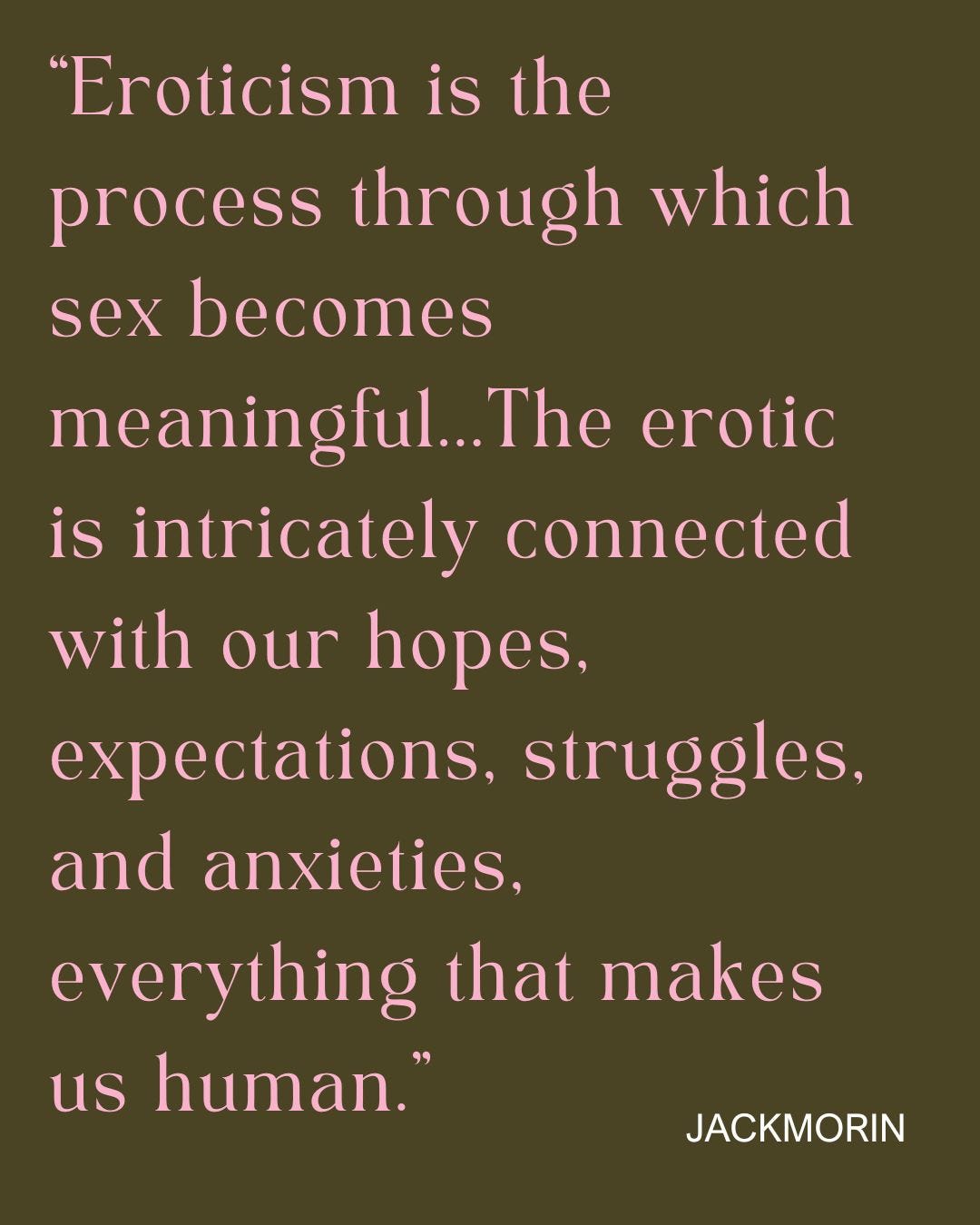
This complexity is not a problem, it is a doorway.
It is what makes the erotic powerful. It refuses to be tidy. It refuses to behave. And that is the gift, because now we can look at the erotic as something to explore.
Curiously.
Playfully.
If the erotic is not a problem to solve, it is a mystery to enter.
My work lives more and more at the intersection of the erotic and the spiritual.
For a long time these two worlds were separated. In the world and in myself.
Spirituality was taught to rise above the body.
Eroticism was reduced to sex.
But the body is not a distraction from the sacred. It is the gateway to it.
Transformation does not happen trough intellectual insight alone.
It happens through sensation.
When the erotic and the spiritual meet, magic happens.
Here are a few reflections for you to take this piece deeper.
When do I feel most alive in my body?
What moments in my life feel quietly erotic, not necessarily sexual, but deeply vivid? (remember the soft egg scene from Wuthering Heights?)
What might it look like to listen more carefully to the erotic within my own body?
What does the erotic mean for me?
If you would like to go deeper, my 1:1 tending is always available for you.
On this journey with you,
Eva
Adore this!
This is so interesting, thank you for writing it! I've been thinking a lot about this recently - I've been disconnected from my body for so long (because, patriarchy and stuff), and learning how to reconnect it involved a lot of experiences that I didn't really know how to name. This has made a lot of sense of that.